Why Does Silence Removal Sound Choppy?
Choppy silence removal often means your threshold is too high or pauses are trimmed too short. Learn settings to tighten dead air without clipping speech.
Read article→Online audio editor
Upload a recording, cut by transcript, remove noise and filler words, and export polished audio — all in your browser.
MP3, WAV, M4A and most browser-supported audio/video files.
Everything you need to edit, clean, and export professional audio in one place.

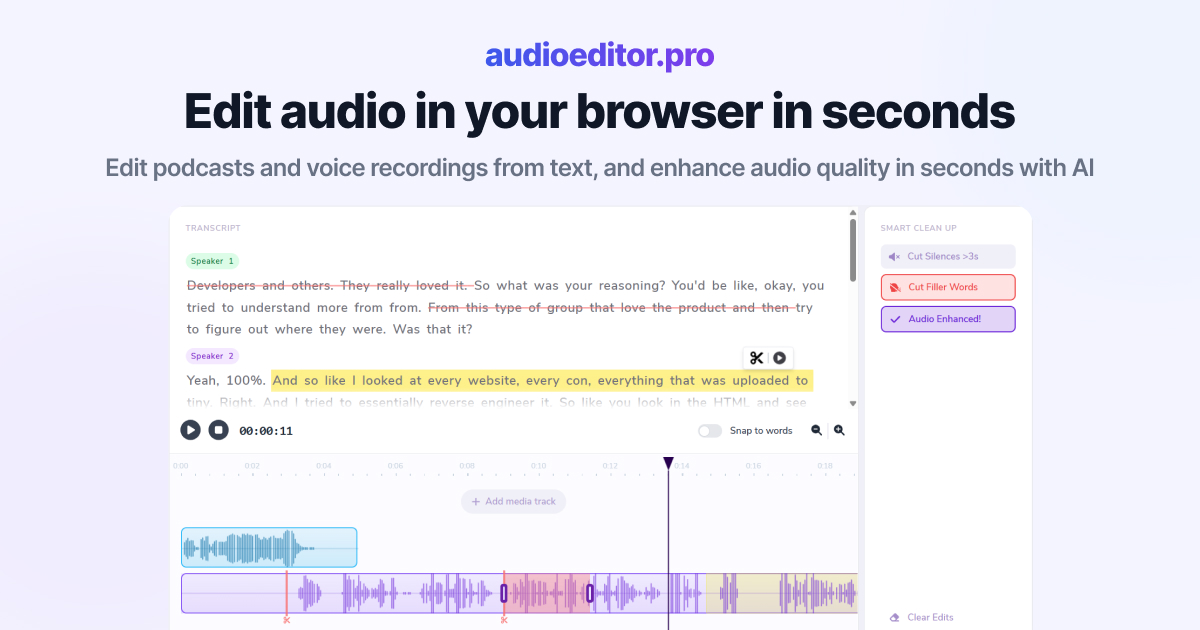
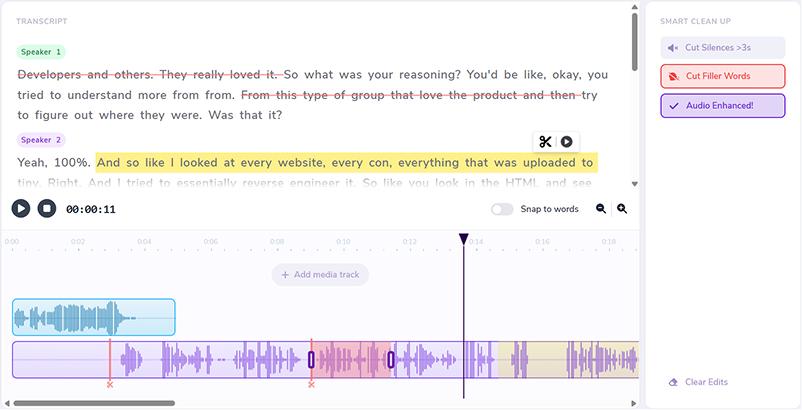
Cut, rearrange, and refine your audio by editing the transcript directly.
Improve clarity, reduce noise, and bring your voice forward with one-click enhancement.
Automatically detect and remove dead air so your episode stays tight and engaging.
Clean up ums, uhs, and verbal fillers without manually hunting through the waveform.
Layer music, intros, voiceovers, and additional audio sources on a shared timeline.
Trim with precision using waveforms, transport controls, and visual cut markers.
Whether you edit podcasts, video, or multi-speaker recordings, the workflow adapts to your format.
Turn raw recordings into publish-ready audio without leaving the browser.
Fix dialogue tracks pulled from camera or screen recordings.
Manage multi-speaker content with transcript-aware editing tools.
Move from first draft to final export in one creator workspace.
Use the transcript for rough cuts and the timeline for fine-grained control.
Remove silences, filler words, and noisy sections without rebuilding the project.
Finish your episode in the same workspace where you uploaded and edited it.
Drop an audio or video file into the editor. The workspace prepares your media and starts transcription automatically.
Select words in the transcript to cut sections, or trim directly on the waveform with transport controls and multi-track lanes.
Remove silences, strip filler words, apply enhancement, and layer extra tracks until the mix sounds right.
Download the edited result from the browser when your episode is ready to publish.
Practical articles on transcript editing, cleanup workflows, and creator audio production.
Choppy silence removal often means your threshold is too high or pauses are trimmed too short. Learn settings to tighten dead air without clipping speech.
Read article→Heavy filler removal can sound robotic when pauses vanish and words land too close. Learn when to cut ums and when to leave speech human.
Read article→Remove ums and uhs automatically from podcast audio with transcription, bulk filler detection, and a quick review pass so cuts stay natural.
Read article→No. The editor runs in the browser. Upload a file, edit on the timeline, and export when you are finished.
Yes. Text-based editing is one of the core workflows. Select words or phrases in the transcript to cut or rearrange the underlying audio.
Yes. You can work with multiple tracks on the same timeline, which is useful for intros, music beds, voiceovers, and layered production.
Yes. Smart cleanup tools help you remove dead air and common verbal fillers so episodes sound tighter without manual scrubbing.
Yes. You can improve clarity and reduce noise as part of the same editing flow, then export the final mix from the browser.
MP3, WAV, M4A, and most browser-supported audio and video formats are supported for upload.